What to Do If You Ghosted an Interview by Mistake
You ghosted an interview by mistake — you forgot, double-booked, or hit an emergency and didn’t show up or notify the hiring manager. Now you’re staring at your phone, wondering if you’ve blown your chance. The good news: a single missed interview doesn’t have to end your candidacy, but how you respond in the next few hours matters more than the mistake itself. This guide walks you through exactly what to do, what to say, and how to prevent it from happening again.
Key Takeaways
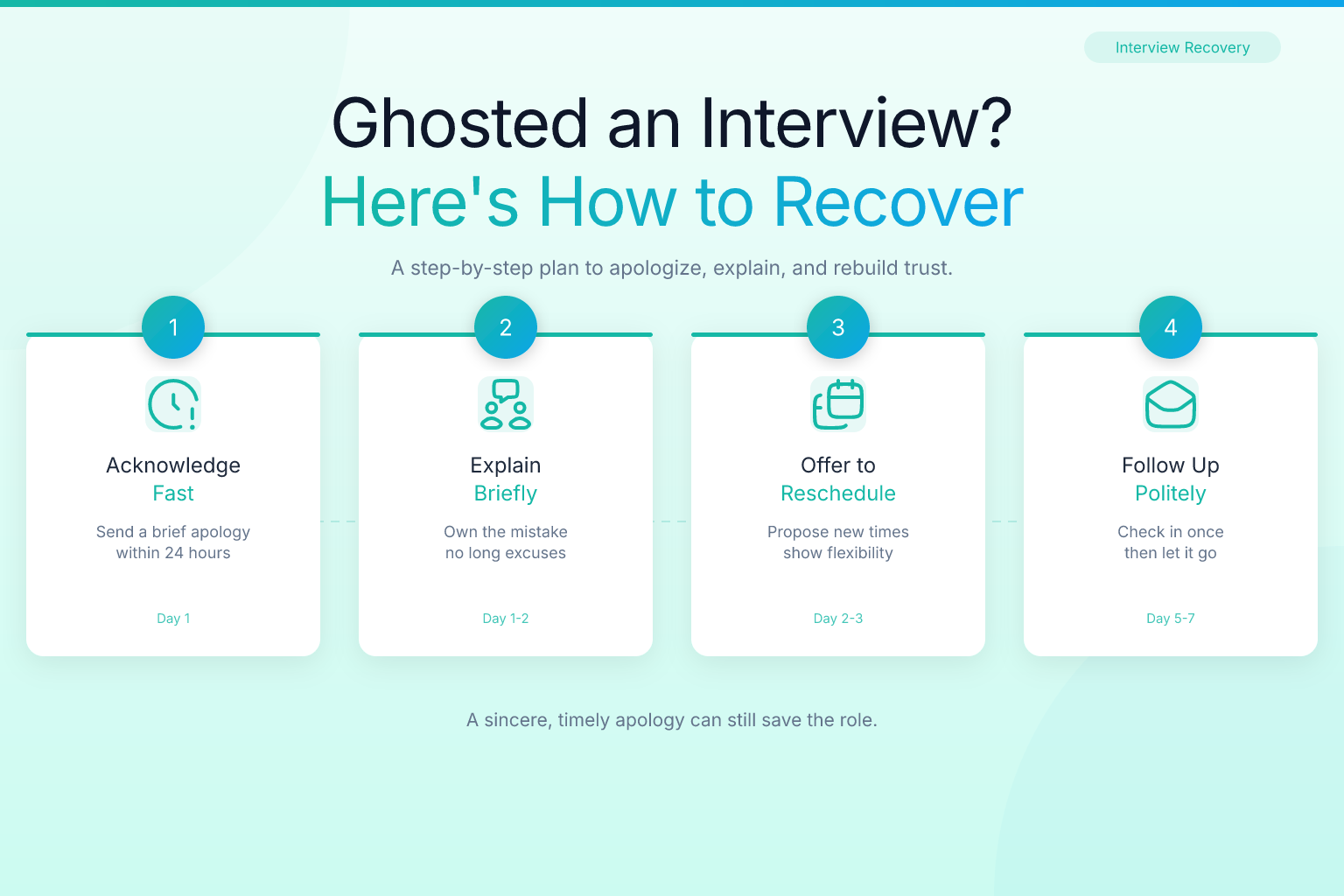
- A sincere, prompt apology email sent within 24 hours is the single most effective way to recover from ghosting an interview by mistake.
- Own the mistake without over-explaining or making excuses; a brief, honest reason (if true) builds more trust than a vague apology.
- Offer a specific alternative time or ask to reschedule, showing you still want the opportunity.
- If the interviewer doesn’t respond, one polite follow-up after 3-5 business days is appropriate; then move on.
- Use a job tracking tool to prevent future ghosting by keeping all interview dates and reminders in one place.
Summary Table
| What to Do | Why It Matters | Time |
|---|---|---|
| Send an apology email within 24 hours | Shows accountability and respect for the interviewer’s time | 15 minutes |
| Offer a specific reschedule time | Demonstrates continued interest and initiative | 5 minutes |
| Follow up once if no response after 3-5 days | Keeps the door open without being pushy | 5 minutes |
| Set up calendar reminders and a job tracker | Prevents repeat mistakes and reduces stress | 10 minutes |
What to Do If You Ghosted an Interview by Mistake: Your First 24 Hours
The moment you realize you missed the interview — whether it was five minutes ago or five hours ago — act. The longer you wait, the more your silence looks like intentional ghosting rather than an honest mistake. Most hiring managers understand that life happens, but they interpret silence as disinterest. A quick, professional response can flip the narrative from “candidate who doesn’t care” to “candidate who made a mistake and owned it.”
Here’s your immediate checklist:
- Stop panicking. A missed interview feels catastrophic, but it’s recoverable in many cases.
- Check the time. If the interview was supposed to start less than an hour ago, you might still be able to join late or send a same-minute apology.
- Find the interviewer’s contact info. Look for the original email, calendar invite, or recruiter’s phone number.
- Send an apology email now. Don’t wait until you’ve crafted the perfect message. A short, sincere note sent within the hour beats a polished one sent tomorrow.
If you realize you missed the interview because you simply forgot, own that. If it was an emergency, say so briefly without oversharing. The goal is to acknowledge the mistake, apologize, and offer a path forward.
Step 1: Send a Sincere Apology Email
Your apology email is the most important piece of this recovery. It should be short, direct, and free of excuses. Hiring managers have seen every version of “my dog ate my calendar,” so skip the elaborate story. A simple, honest explanation — if you have one — works better than a wall of text.
Here’s a template you can adapt:
Subject: Apology for missing today’s interview — [Your Name]
Body:
Dear [Interviewer’s Name],
I’m writing to sincerely apologize for missing our interview scheduled for [time] today. I [brief reason: “had an unexpected family emergency” / “completely lost track of time due to a scheduling error on my end” / “misread the calendar invite”].
I take full responsibility and understand this reflects poorly on my reliability. I’m still very interested in the [Job Title] role and would be grateful for the chance to reschedule at your convenience. I’m available [list 2-3 specific time windows over the next few days].
Thank you for your understanding, and again, I’m sorry for the inconvenience.
Best, [Your Name] [Your Phone Number]
Key points to remember:
- Don’t over-apologize. One clear apology is enough. Groveling makes you look desperate and unprofessional.
- Be honest but brief. If you forgot, say you forgot. If it was an emergency, say “unexpected personal emergency” without details.
- Never lie. If you claim a family emergency when you actually overslept, you risk being caught in the lie later.
- Include your phone number. It makes it easy for the interviewer to call you back quickly if they’re willing to reschedule.
Step 2: Offer a Solution — Propose a New Time
An apology without a solution is just words. After you’ve said sorry, immediately offer concrete times to reschedule. This shows you’re still invested and makes it easy for the interviewer to say yes.
Instead of writing “Let me know if you’d like to reschedule,” write:
“I’m available tomorrow between 10am and 2pm, Thursday after 3pm, or Friday morning. Would any of those work for you?”
If you missed the interview because of a genuine emergency, you can add a line like:
“The situation is now resolved, and I’m fully available to meet at your earliest convenience.”
If you forgot, don’t dwell on it. A simple “I had a scheduling mix-up on my end” is enough. The interviewer doesn’t need a play-by-play of your morning.
Proposing specific times also signals that you respect their calendar. It turns the conversation from “you messed up” to “let’s find a new time that works.”
Step 3: Follow Up If You Don’t Hear Back
You sent the apology. Now what? If you don’t get a response within 3-5 business days, send one polite follow-up. This is where many candidates give up, but a single follow-up can make the difference.
Here’s a follow-up template:
Subject: Following up on my apology — [Your Name]
Dear [Interviewer’s Name],
I wanted to follow up on my email from [day] regarding the missed interview. I remain very interested in the [Job Title] role and would still love the opportunity to speak with you. If rescheduling isn’t possible, I completely understand and appreciate your time.
Thank you again for your consideration.
Best, [Your Name]
Keep it short. Don’t send more than one follow-up. If you still hear nothing, it’s time to move on. For more on handling silence after an interview, read our guide on what to do when you get no response after an interview.
What If the Interviewer Never Responds?
Sometimes, no matter how sincere your apology, the company won’t respond. That’s frustrating, but it’s also common. Hiring managers are busy, and some companies have strict policies about missed interviews — especially for high-volume roles.
If you’ve sent an apology and one follow-up with no reply, accept that this particular opportunity is likely gone. Don’t send a third email. Don’t call the office repeatedly. Don’t show up in person. That crosses from persistent to pushy and can damage your reputation with that company and others (recruiters talk).
Instead, channel that energy into other applications. One missed interview doesn’t define your job search. If you’re worried about how this looks on your record, remember that most companies don’t share candidate no-show information with each other. Your next application starts fresh.
How to Prevent Ghosting an Interview Again
The best apology is prevention. If you ghosted an interview because you forgot or double-booked, your system failed you. Fix the system.
Here’s what works:
- Use a calendar with multiple reminders. Set alerts 24 hours before, 2 hours before, and 30 minutes before every interview. Put the interview location (or video link) in the event description.
- Track every application and interview in one place. The ResumeMate Job Tracker is a free Chrome extension that logs every application, interview date, and follow-up deadline right from your browser. You’ll see all upcoming interviews at a glance, so nothing slips through.
- Confirm the interview details in writing. After scheduling, reply to the email with “Confirmed — I’ll see you on [date] at [time].” This forces you to double-check the date and time.
- Prepare the night before. Lay out your outfit, test your video link, and review your notes. The act of preparation makes the interview feel real and harder to forget.
- Set a backup alarm. If your interview is at 10am, set an alarm for 9:30am that says “Interview in 30 minutes.” Put your phone across the room so you have to get up.
For a full pre-interview checklist, see our guide on how to prepare for an interview.
Can You Still Get the Job After Ghosting?
The honest answer: sometimes yes, sometimes no. It depends on the company, the role, and how you handled the apology.
When you have a good chance:
- You apologized within a few hours with a clear, honest reason.
- The role is hard to fill or you were a strong candidate before the miss.
- The interviewer is understanding and has made similar mistakes themselves.
- You offered specific reschedule times and followed up politely.
When the chance is slim:
- The company has a strict no-show policy (common in high-volume customer service or retail roles).
- You waited days to apologize, making it look like intentional ghosting.
- The role had dozens of equally qualified candidates.
- You made excuses or lied about the reason.
Even if this particular job is lost, the way you handle the mistake can leave a positive impression. A hiring manager who sees you own your error and act professionally may remember you for future openings. And if the company rescinds an offer later for another reason, you’ll know how to respond — check our guide on what to do if a job offer is rescinded for a similar recovery playbook.
FAQ
Q: What does it mean to ghost an interview?
A: Ghosting an interview means failing to show up or communicate that you won’t attend, without any notice to the employer. It’s the job-seeker equivalent of a company going silent after an interview. If you missed an interview by accident and didn’t notify them, you ghosted — even if it wasn’t intentional.
Q: Should I apologize for missing an interview?
A: Yes, always. Even if you think the opportunity is gone, a brief apology email shows professionalism and respect. It takes five minutes and can salvage the relationship, even if not the specific job. Silence after a miss makes you look careless and burns a bridge.
Q: How do I write an apology email for missing an interview?
A: Keep it short: acknowledge the miss, give a brief honest reason (if you have one), apologize sincerely, and offer specific times to reschedule. Avoid long explanations or excessive groveling. Use the template in this guide as a starting point and customize it with your details.
Q: Can I reschedule an interview after missing it?
A: Yes, in many cases. If you apologize promptly and propose new times, many hiring managers will reschedule — especially if you were a strong candidate. The key is to act within 24 hours and make it easy for them to say yes by offering specific availability.
Q: Will ghosting an interview ruin my chances with that company?
A: Not necessarily. A prompt, sincere apology can often recover the situation. However, if the company has a strict no-show policy or the role is highly competitive, the chance may be gone. Even then, a professional apology leaves a better impression than silence.
Q: How long should I wait before following up after an apology?
A: Wait 3-5 business days. If you haven’t heard back, send one polite follow-up restating your interest and asking if rescheduling is possible. After that, stop. More than one follow-up crosses into pushy territory and won’t help.
Q: What if I ghosted a phone interview by mistake?
A: The same steps apply. Send an apology email immediately, explain the miss briefly, and offer to reschedule the call. Phone interviews are often easier to reschedule because they require less coordination. Just be prompt and professional.
Q: Is it better to lie about why I missed the interview?
A: No. Never lie. If you forgot, say you forgot. If it was an emergency, say “unexpected personal emergency” without details. Lying about a family death or illness can backfire if the interviewer asks follow-up questions or checks your story. Honesty, even when it’s embarrassing, builds more trust.
Related articles:
- What Happens If You Fail a Pre-Employment Drug Test?
- What to Do If a Background Check Reveals Old Debt
Track Every Application While You Job Hunt
Stop losing track of where you’ve applied. The ResumeMate Job Tracker is a free Chrome extension that tracks every application, deadline, and follow-up in one place — right from your browser.