You’ve found a company you’d love to work for, but they aren’t advertising any open roles. Writing a cover letter when there is no job posting — often called a cold cover letter or letter of interest — can feel like shouting into the void. Without a job description to mirror, what do you actually say? The good news: a well-crafted speculative cover letter can open doors that never hit a job board. It shows initiative, research, and genuine interest — qualities every hiring manager wants. This guide breaks down exactly what to put in a cover letter when there’s no job posting, with a template and real examples you can adapt today.
Key Takeaways
- Research the company to find a specific trigger—like a recent funding round, product launch, or team expansion—and mention it in your opening to show you’ve done your homework and aren’t sending a generic letter.
- Structure your value proposition as a PAR (Problem-Action-Result) story that demonstrates how you solved a similar challenge elsewhere, using concrete numbers when possible.
- End with a low-friction ask, such as a 15-minute call to learn about their team’s priorities, rather than directly requesting a job or interview.
- Keep the letter under 300 words, address it to a specific person found via LinkedIn, and always attach a clean PDF resume.
- Follow up once after 5–7 business days with a brief, polite email that references your original message and offers an easy out if they’re not interested.
Core Elements of a Speculative Cover Letter
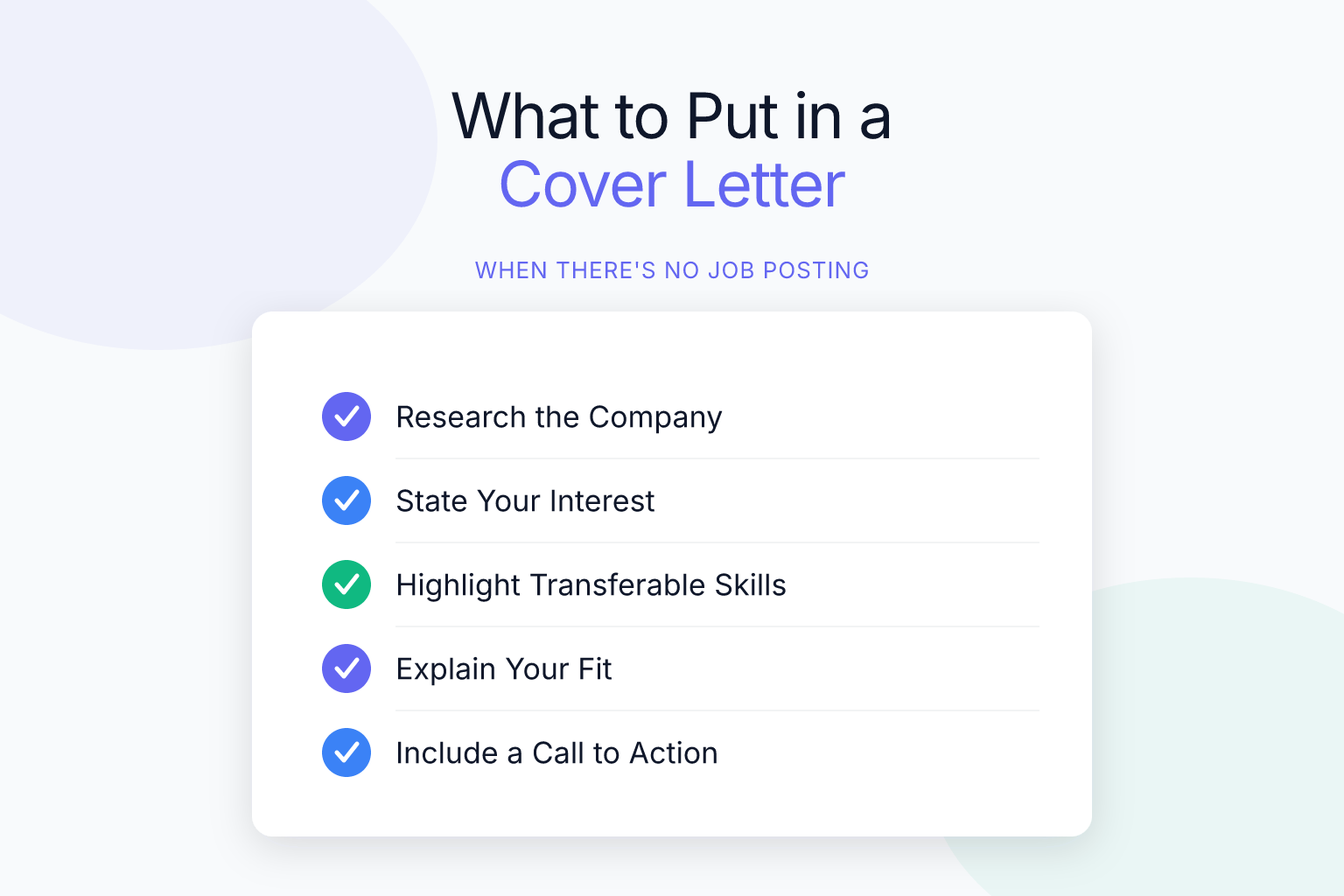
A speculative cover letter must do more heavy lifting than a standard application. Without a job description, every sentence must justify why you’re writing and why the reader should care. Here are the five non-negotiable elements:
- A clear reason for reaching out. Reference a specific project, product launch, news article, or team challenge that prompted you to write. This proves you’ve done your research and aren’t mass-emailing.
- A value proposition tied to the company’s needs. Identify a problem they likely face — based on your research — and explain how you’d solve it.
- A brief, compelling story of past impact. Use a PAR (Problem-Action-Result) or STAR format to show you’ve solved similar challenges before. This replaces the “requirements” section of a traditional cover letter.
- A specific, low-friction ask. Don’t say “I’d like a job.” Instead, request a 15-minute call to learn more about their team, or ask if they’d be open to keeping your resume on file for future roles.
- Your resume attached as a PDF. A clean, single-column resume (like the ones you can build free with ResumeMate’s AI resume builder) gives them something concrete to review. Never send a Word document unless specifically requested — modern ATS and email systems parse PDFs just fine.
How to Research the Company and Identify a Need
Without a job posting, your research becomes the foundation of the entire letter. You’re not matching keywords; you’re identifying a gap you can fill.
Start with the company’s website. Read their “About” page, blog, press releases, and leadership bios. Look for:
- Recent funding rounds or growth announcements (they may be hiring soon)
- New product launches or feature rollouts (they may need support)
- Pain points mentioned in case studies or customer stories
- Team pages that show missing roles (e.g., a marketing team with no content specialist)
Next, check LinkedIn. Look at the company page and recent posts. See if employees have changed roles or left — a departure can signal an upcoming opening. Follow the hiring manager or department head you’d report to; their activity often reveals priorities.
Finally, search for news articles, interviews with executives, or industry reports that mention the company. If the CEO just gave an interview about expanding into a new market, that’s your hook. You can write: “I saw your interview in TechCrunch about expanding into enterprise — my background in enterprise sales at [Previous Company] could help accelerate that growth.”
This research step takes 20–30 minutes but makes the difference between a letter that gets deleted and one that gets a reply.
Crafting Your Message: Opening and Value Proposition
Hiring managers and founders get dozens of cold emails. Most start with “I’m reaching out because I admire your company.” That’s forgettable. Your opening must do two things: show you’ve done your homework and hint at the value you bring.
Subject line examples:
- “Ideas for scaling your content team (saw your Series B news)”
- “Congrats on the [Product] launch — a quick thought on user onboarding”
- “Your expansion into [Market] and my experience at [Relevant Company]”
First sentence: Reference the specific trigger that made you write. For example:
- “I read your recent blog post about reducing churn in SaaS, and it mirrored a challenge I solved at [Previous Company] — reducing churn by 22% in six months.”
- “Congratulations on the Series A. As you scale the engineering team, my background in building microservices at [Previous Company] could help you avoid the growing pains we navigated there.”
Avoid generic flattery. Instead, connect their world to yours immediately.
Showcasing your value without a job description. When there’s no list of requirements, focus on outcomes, not just skills. Identify 2–3 problems the company likely faces, then tell a PAR story. For a marketing role at a B2B SaaS company:
“At [Previous Company], we struggled to convert free trial users to paid plans. I redesigned the onboarding email sequence, adding personalized video walkthroughs. Within three months, trial-to-paid conversion increased from 12% to 19%, generating an additional $340K in annual recurring revenue.”
This story works because it’s concrete, measurable, and relevant — even without a job description. If you’re early in your career, use academic projects, internships, or volunteer work with the same problem-action-result structure.
Structuring Your Letter and Making the Ask
A speculative cover letter should be short — under 300 words — so you have room for only one or two strong examples. The PAR approach keeps you focused.
Body structure that works:
- The connection paragraph (2–3 sentences): Explain why you’re writing, referencing your research. “I’ve been following [Company] since your [Product] launch, and I noticed you’re expanding the customer success team. That’s where I can help.”
- The proof paragraph (3–4 sentences): Your PAR story. Lead with the problem, describe your action, and close with the result. Use numbers when possible.
- The bridge paragraph (1–2 sentences): Connect your past success to their future. “I see a similar opportunity at [Company] — as you scale, a structured onboarding process could reduce churn and increase expansion revenue.”
- The ask (1 sentence): A clear, low-pressure request. “Would you be open to a 15-minute call next week? I’d love to learn more about your plans for the team.”
Good asks:
- “Would you be open to a brief call in the next few weeks? I’d love to hear more about your priorities for the engineering team.”
- “If you’re willing, I’d appreciate 15 minutes to share how I approached a similar challenge at [Previous Company].”
- “If now isn’t the right time, I’d be grateful if you’d keep my resume on file for future opportunities.”
Bad asks:
- “I’d like to apply for a position at your company.” (Too vague)
- “Can we schedule an interview?” (Presumptuous)
- “I’m available to start immediately.” (Desperate)
Always give them an easy out. If they’re not hiring, they can still keep your information. This builds goodwill and keeps the door open.
Common Mistakes to Avoid
Even a well-researched letter can fail if you make these errors:
- Sending a generic template. If you could swap the company name and send it to ten other places, it’s not specific enough.
- Focusing on what you want. “I’m looking for a challenging role” is about you. “I can help you reduce customer churn” is about them.
- Writing too much. A cold email longer than 300 words rarely gets read. Be ruthless with editing.
- Forgetting to attach your resume. Use a clean, ATS-friendly PDF. You can check your resume’s ATS score free before sending to make sure it’s readable.
- Not following up. One email is easy to miss. Send a polite follow-up after 5–7 business days (see the template below).
- Addressing it “To Whom It May Concern.” Find a specific person on LinkedIn. If you absolutely can’t, “Dear [Team Name] Team” is better than the generic alternative.
For more on when a cover letter is actually necessary, read our guide on whether you need a cover letter at all.
Speculative Cover Letter Example and Template
Here’s a full example for a product manager reaching out to a startup that just raised funding.
Subject: Your Series A and a thought on scaling product ops
Dear [Hiring Manager Name],
Congratulations on the Series A — I saw the announcement in [Publication]. As you scale from 30 to 80 people this year, I imagine product operations will become a critical need.
At [Previous Company], I joined as the first product ops hire after their Series A. The team was shipping fast but struggling with cross-functional alignment. I built a lightweight roadmap process and introduced weekly stakeholder syncs. Within six months, on-time delivery improved by 35%, and the engineering team’s sprint velocity increased by 20%.
I see a similar inflection point at [Company]. With the right processes in place early, you can avoid the bottlenecks that slow down most growing startups. I’d love to share what worked for us — would you be open to a 15-minute call in the next few weeks?
I’ve attached my resume for context. If now isn’t the right time, I’d be grateful if you’d keep it on file.
Best, [Your Name] [LinkedIn Profile] [Phone Number]
Template:
Subject: [Specific trigger] and a thought on [relevant area]
Dear [Name],
[1–2 sentences referencing their news, project, or challenge].
[PAR story: Problem you faced, Action you took, Result you achieved — 3–4 sentences].
[1–2 sentences connecting your experience to their current situation].
[Low-friction ask — 1 sentence].
[Optional: fallback ask if they’re not hiring].
Best, [Your Name]
For more creative approaches to cover letters, check out our guide on how to write a creative cover letter that gets noticed.
How to Follow Up After Sending a Cold Cover Letter
Most people never follow up, which means a polite nudge can set you apart. Wait 5–7 business days, then send a brief email that references your original message.
Follow-up template:
Subject: Quick follow-up on my note last week
Hi [Name],
I wanted to follow up on the email I sent last week about [topic]. I know you’re busy — if it’s easier, I’m happy to connect whenever it’s convenient.
If now isn’t the right time, no worries at all. I’ll keep an eye on [Company]’s progress and would welcome the chance to chat in the future.
Best, [Your Name]
Keep it short. Don’t re-pitch your entire value proposition. The goal is to stay on their radar without being pushy. If you don’t hear back after a second follow-up, move on — but you’ve planted a seed that may pay off months later.
Frequently Asked Questions
Can I send a cover letter without a job posting?
A: Yes. This is called a cold cover letter or letter of interest. It’s a proactive way to introduce yourself to a company you want to work for, even if they aren’t actively hiring. Many roles are filled through networking and referrals before they’re ever posted, so a well-timed letter can put you on the radar early.
What should the subject line be for a cold email cover letter?
A: Your subject line should reference a specific trigger — a news article, product launch, funding announcement, or shared connection. Examples: “Ideas for scaling your content team (saw your Series B news)” or “Your expansion into [Market] and my experience at [Relevant Company].” Avoid generic lines like “Job Inquiry” or “Resume Attached.”
How do I address a cover letter with no job posting?
A: Find a specific person on LinkedIn — the department head, team lead, or founder. Use “Dear [First Name].” If you can’t find a name, “Dear [Team Name] Team” (e.g., “Dear Marketing Team”) is better than “To Whom It May Concern.” Never use “Dear Sir/Madam.”
Should I attach a resume to a speculative cover letter?
A: Yes, always attach your resume as a PDF. It gives the recipient something concrete to review and share with colleagues. Use a clean, single-column format that’s ATS-friendly. You can build one free with ResumeMate’s AI resume builder and check its ATS score before sending.
How long should a speculative cover letter be?
A: Keep it under 300 words. Busy professionals skim emails; a concise, well-structured letter is more likely to be read in full. Focus on one strong PAR story and a clear ask.
What if the company has no open positions?
A: That’s exactly when a speculative letter works. Your ask should be for a conversation, not a job. If they’re not hiring, they may keep your resume on file or refer you to someone else. The goal is to start a relationship, not to get hired immediately.
When does a speculative cover letter work best?
A: Cold outreach is most effective when you have a strong connection to the company’s mission or product, you’re targeting a specific team where you have proven expertise, the company is growing or in transition (funding, new leadership, market expansion), and you can offer a clear solution to a known problem. If you’re making a career change, a speculative letter can be especially powerful because it lets you frame your transferable skills before a job description filters you out. Read our guide on writing a career change cover letter for more strategies.
How do I follow up if I don’t get a response?
A: Wait 5–7 business days, then send a brief, polite follow-up. Reference your original email, keep it under 100 words, and offer an easy out. If you still don’t hear back after a second follow-up, move on — but you’ve made an impression that could pay off later.
Related articles:
- Translating Obscure Internal Job Titles to Market Standards
- What Questions Do Employers Ask in Reference Checks? (Tips)
- Resume Statistics: What Data Says About Hiring in 2026
- Internal Transfer vs New Job Cover Letter: Key Differences
- How to Address a Cover Letter When You Don’t Know the Name
- What to Put in a Cover Letter Subject Line
- Australian CV & Cover Letter PDF: Free Download & Guide
- Best Time of Day to Send a Job Application Email
- Follow Up After Application with No Job Posting
- List Multiple Short-Term Jobs (No Job Hopper Look)
Track Every Application While You Job Hunt
Stop losing track of where you’ve applied. The ResumeMate Job Tracker is a free Chrome extension that tracks every application, deadline, and follow-up in one place — right from your browser.