GPA on Resume: When to Include It & How to Format (2026 Guide)
Deciding when to include GPA on a resume can feel like a guessing game. Put it on and risk looking like you’re clinging to college glory days. Leave it off and a recruiter might assume the worst. The truth is, there are specific, practical rules that tell you exactly when your GPA helps your application — and when it’s better to leave it in the past. This guide breaks down every scenario so you can make the right call in 2025.
Quick Reference: GPA Rules
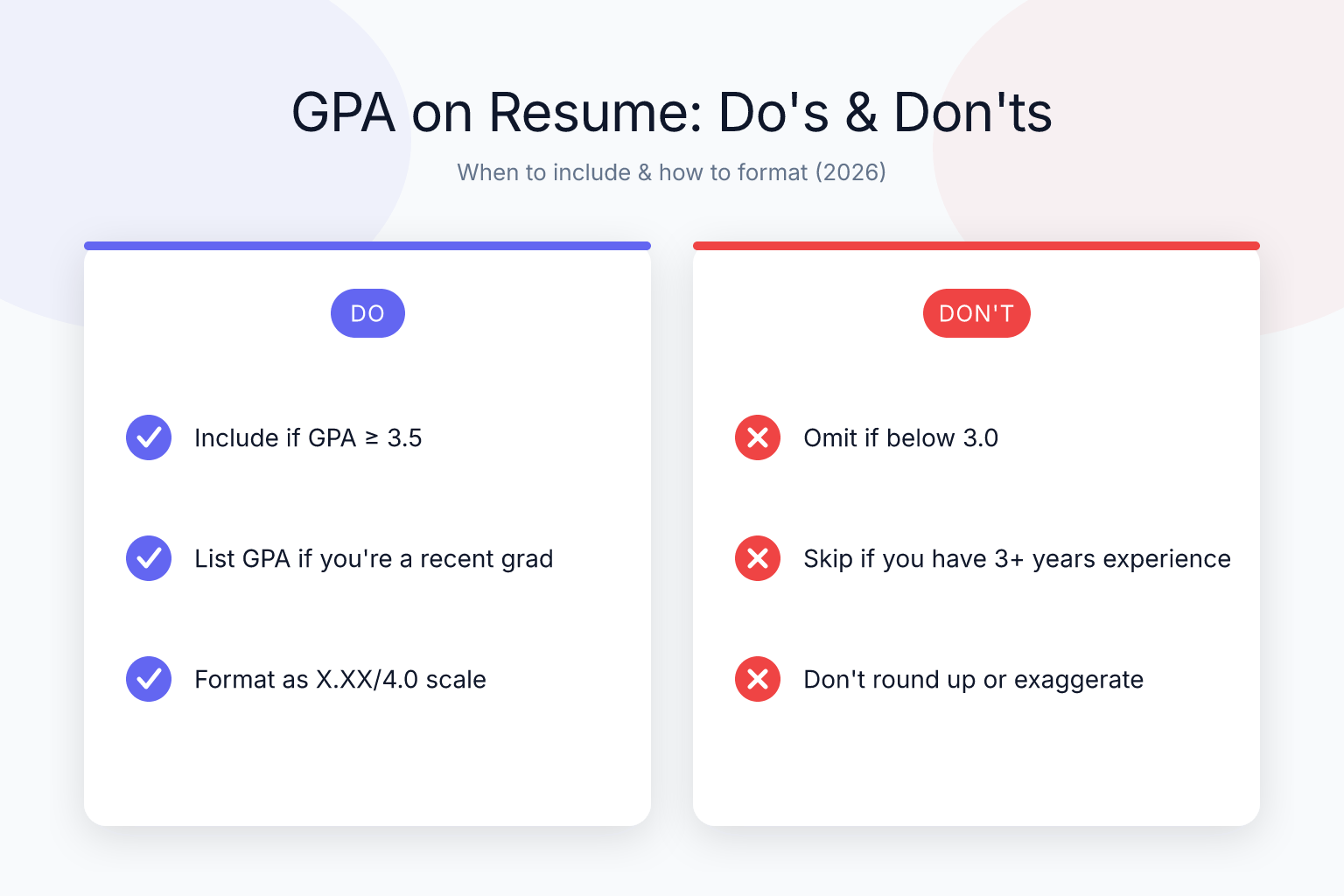
Before diving into the details, here are the core rules that cover most situations. Use the table and takeaways below as a fast decision-making tool. If you’re a recent graduate with a 3.0 or higher, include your GPA. Once you have two to three years of professional experience, your work achievements matter far more than your grades, so you can safely remove it. For competitive fields like consulting, finance, or academia, a strong GPA (3.5+) remains relevant even mid-career. Always be honest — never round up or misrepresent your GPA. The following summary and table give you an at-a-glance view of when to include, omit, or adjust your GPA on a resume.
Key Takeaways
- Include your GPA on a resume only if it’s 3.5 or above (or 3.0+ for your first job out of school).
- Remove your GPA entirely once you have 2–3 years of professional, full-time experience — your work achievements matter more.
- If you’re a recent graduate with a lower GPA, strengthen your resume with relevant coursework, projects, and internships instead.
- For academic, research, or highly competitive fields, a strong GPA remains relevant even beyond entry-level.
- Never round up your GPA dishonestly; list it exactly as it appears on your transcript.
Summary Table: When to Include Your GPA
| What to Do | Why It Matters | Time to Apply |
|---|---|---|
| Include GPA if 3.5+ (or 3.0+ for first job) | Signals strong academic performance to employers who still weigh it | First 1–3 years after graduation |
| Omit GPA if below 3.0 | A low GPA can hurt more than it helps; focus on skills and experience | Always |
| List major GPA if higher than cumulative | Shows strength in your field even if overall GPA is lower | When cumulative is below 3.0 but major GPA is 3.5+ |
| Remove GPA after 2–3 years of work experience | Employers prioritize professional achievements over academics | After 2–3 years in a relevant role |
| Keep GPA for academic, research, or highly competitive roles | Some fields (consulting, finance, academia) still value GPA mid-career | As long as it’s a 3.5+ and relevant |
When to Include (and When to Leave Off) Your GPA
When to Include Your GPA
You’re a recent graduate (0–3 years out of school). For new graduates, education is your primary qualification. Employers expect to see a GPA on entry-level resumes, and leaving it off can raise questions. Include it if your cumulative GPA is 3.0 or above; for 3.5 or higher, it’s a strong selling point. If you’re still in school and applying for internships, list your current GPA as long as it’s 3.0 or above, noting it as “GPA: 3.4 (through Fall 2025)” to show it’s in-progress.
Your GPA is 3.5 or above (any career stage). A GPA of 3.5 or higher is worth keeping even beyond entry-level, especially in fields that value academic performance: consulting, investment banking, law, academia, research, and some competitive tech firms. If you graduated with honors (cum laude, magna cum laude, summa cum laude), list that instead of or alongside your GPA — it conveys the same message with more prestige.
The job posting specifically requests GPA. Some employers in finance, consulting, and government explicitly ask for GPA. If they ask, you must include it, regardless of the number. Omitting it when requested can get your application filtered out before a human sees it.
You’re a career changer with a strong GPA in a relevant degree. If you went back to school for a second degree or a master’s to pivot careers, a high GPA in that program signals your commitment and capability in the new field. Include it even if you have years of unrelated work experience.
When to Leave Your GPA Off
Your cumulative GPA is below 3.0. A GPA below 3.0 can hurt more than it helps. Recruiters may interpret it as a lack of effort or ability, even if you had valid reasons. Unless the employer specifically requires it, leave it off. Your resume is a marketing document, not a transcript.
You have 3+ years of relevant professional experience. Once you’ve been in the workforce for a few years, your professional accomplishments carry far more weight than your college grades. A hiring manager for a mid-level position cares about your last role’s results, not your sophomore-year chemistry grade. Drop the GPA and let your experience do the talking.
Your major GPA is strong but cumulative is weak. If your overall GPA is below 3.0 but your major GPA is 3.5 or higher, you can list just the major GPA — but label it clearly as “Major GPA.” Never present it as your cumulative GPA.
You graduated more than 5 years ago. After five years, your GPA is rarely relevant. Even a 4.0 can make you look like you’re living in the past. Focus on your career trajectory instead.
How to List GPA on a Resume
Once you’ve decided to include your GPA, format it correctly. Poor formatting can confuse ATS software or make your resume look sloppy.
Placement: Your GPA belongs in the Education section, directly after your degree and university name. It should be on the same line as your degree or the line immediately below. Do not put it in your contact header or summary.
Formatting examples:
Standard format:
Bachelor of Science in Computer Science
University of Michigan, Ann Arbor, MI | May 2024
GPA: 3.8/4.0
With honors:
Bachelor of Arts in Economics
University of Texas at Austin, TX | December 2023
GPA: 3.9/4.0 — Summa Cum Laude
Major GPA only:
Bachelor of Business Administration
Arizona State University, Tempe, AZ | May 2025
Major GPA: 3.7/4.0
Rules to follow:
- Always include the scale (e.g., “/4.0”) so the number has context.
- Use the exact GPA from your transcript. Do not round up. A 3.49 is not a 3.5.
- If your school uses a different scale, convert it to a 4.0 scale or list it with the original scale noted.
- For Latin honors, you can list the honor alone if you prefer: “Cum Laude” instead of the numeric GPA.
Special Cases: CVs, Career Changers, and No Experience
GPA on a CV vs. Resume
A CV (curriculum vitae) is used primarily for academic, research, and international roles. In academia, your GPA is often expected, especially for graduate school applications, fellowships, and research positions. Include undergraduate GPA if 3.0+, and always include graduate GPA. You can also list relevant coursework grades. For more on the differences, see our guide on graduate CV vs. resume: what to use when.
What If You’re a Recent Graduate With No Work Experience?
If you have little to no professional experience, your education section becomes the centerpiece. A strong GPA can help compensate for a thin work history. Lead with your education, include your GPA, and add bullet points for relevant coursework, academic projects, and honors. Pair this with internships, volunteer work, or leadership roles. For ideas on filling out a sparse resume, read our guide on how to list volunteer work on a resume with no experience.
If your GPA is weak, move the education section below any experience you do have — even part-time jobs or freelance work. Instead of GPA, highlight relevant coursework, capstone projects, leadership roles, and skills. You can also use a resume objective to frame your career goals and enthusiasm, drawing attention away from the GPA.
Common GPA Scenarios
- GPA 3.7, 2 years of experience: Include it. It’s still recent and strong enough to help.
- GPA 3.2, 5 years of experience: Leave it off. Your experience outweighs a middling GPA.
- GPA 2.9, no experience, first job: Leave it off. Focus on projects, coursework, and skills.
- GPA 3.9 in master’s program, 10 years of unrelated experience: Include it. It shows capability in the new field.
- GPA 3.5, but you had a 2.5 in your first two years: List your GPA if the upward trend is clear, or list your major GPA or last-60-credits GPA. Label it clearly: “Upper-Division GPA: 3.8.”
- Employer asks for GPA on application form: Always provide it honestly. Lying on an application is grounds for termination.
How Employers and ATS Systems View GPA
Most large companies use ATS software to parse resumes. These systems look for keywords and structured data. Your GPA, if included, is just another data point. An ATS won’t reject you for a low GPA unless the employer sets a specific cutoff filter — which is rare outside of highly competitive campus recruiting programs. However, if a job posting says “GPA of 3.0 or above required,” the ATS may filter out resumes that don’t include a GPA or list one below the threshold. In those cases, you must include it to pass the screen.
Human recruiters spend an average of 6–7 seconds on an initial resume scan. A high GPA catches the eye as a positive signal. A low GPA can be a negative signal — but only if they notice it. If your experience is strong, they may not even look at your GPA. For most roles, recruiters care far more about your skills, experience, and fit than your college grades. The exception is campus recruiting for competitive industries, where GPA is often used as a quick filter.
Tips for Strengthening Your Resume Without a GPA
If you’ve decided to leave your GPA off, you need other elements to make your resume stand out.
Lead with a strong summary. A well-written professional summary at the top of your resume can immediately grab attention. Focus on your key skills, years of experience, and one or two notable achievements.
Quantify your achievements. Numbers speak louder than grades. Wherever possible, add metrics to your work experience: “Increased sales by 20%,” “Managed a $50,000 budget,” “Led a team of 5.” If you struggle to find numbers, our guide on how to add numbers to your resume when you don’t have data can help.
Highlight certifications and skills. Industry certifications, technical skills, and language proficiencies can outweigh a GPA. Create a dedicated skills section and list certifications prominently. For guidance on placement, see certifications and licenses on a resume: where and how.
Use your cover letter. If you’re worried a low GPA might be a red flag, address it briefly in your cover letter — but only if you have a compelling explanation (e.g., you worked full-time while in school). Frame it as a story of resilience and time management. Never apologize for your GPA; explain what you learned.
Get your resume scored. Not sure if your resume is strong enough without a GPA? Use a free tool like the ResumeMate score checker to get instant feedback on your resume’s ATS compatibility, section strength, and overall impact.
FAQ
Q: When should I include my GPA on my resume?
A: Include your GPA if you’re a recent graduate (0–3 years out of school) with a 3.0 or above, if your GPA is 3.5+ at any career stage in a field that values academics, or if the job posting specifically requests it. Otherwise, leave it off.
Q: When should I not include my GPA on my resume?
A: Leave your GPA off if it’s below 3.0, if you have more than 3 years of relevant professional experience, or if you graduated more than 5 years ago. In these cases, your GPA is more likely to hurt than help.
Q: Should I put my college GPA on my resume if I’m a career changer?
A: If you recently completed a new degree relevant to your target field and your GPA is 3.5 or above, include it — even if you have years of unrelated experience. It shows your capability in the new domain. If the GPA is lower, focus on projects and skills from the program instead.
Q: Can I list my major GPA instead of my cumulative GPA?
A: Yes, as long as you label it clearly as “Major GPA.” This is acceptable when your major GPA is significantly higher than your cumulative GPA. Never present your major GPA as your overall GPA.
Q: Do employers actually check GPA?
A: Some do, especially for entry-level roles in competitive industries like consulting, finance, and tech. Many employers will verify your GPA during a background check if they’ve made a conditional offer. Always be honest about your GPA.
Q: What if my GPA is low but I had extenuating circumstances?
A: If you had a significant reason (illness, family emergency, full-time work), you can briefly address it in your cover letter — but only if you can frame it positively. Focus on what you learned and how you overcame the challenge. On the resume itself, leave the GPA off.
Q: Is a 3.0 GPA good enough to put on a resume?
A: For a first job or internship, yes. A 3.0 meets the minimum threshold many employers use. Once you have 1–2 years of experience, a 3.0 is no longer impressive enough to include — let your work results take over.
Related articles:
- Customize LinkedIn URL for Resume: Clean Professional Link
- Receptionist Resume: Phone & Scheduling for Interviews
- Medical Assistant Resume Examples (2026 Guide)
- Best Time to Post on LinkedIn for Job Seekers (2026 Guide)
- QR Code on Resume: Good Idea or Gimmick?
- Two Page Resume Acceptable for Mid-Level Managers? 2026
- Awards to Put on Resume for High School Students
- Remote Work Skills to Put on Resume 2026: A Complete Guide
- Board Membership on Resume: Non-Profit Guide
- Pronouns on Resume & LinkedIn: Should You Include Them?
- Google Docs Resume to PDF: Zero Formatting Errors
- Resume Keywords for Nonprofit & NGO Jobs: Complete Guide
- Resume for Career Break Due to Illness: Step-by-Step Guide
- Executive Resume Examples for C-Suite Positions
- Explain Job Hopping on a Resume Without Sounding Unreliable
- How to List Publications on a Resume for Non-Academic Jobs
- How to Include Security Clearance on Resume: 2025 Guide
- Create a Portfolio Website for Resume Links (and Why)
Track Every Application While You Job Hunt
Stop losing track of where you’ve applied. The ResumeMate Job Tracker is a free Chrome extension that tracks every application, deadline, and follow-up in one place — right from your browser.