You’ve made it past the resume screen, maybe even aced the first round, and then the interviewer leans forward and asks: “Why should we hire you?” It’s one of the most direct — and intimidating — questions you’ll face. But it’s also your biggest opportunity to sell yourself as the solution to the company’s problem. This guide breaks down exactly how to structure a winning answer, with sample scripts for different career stages and practical tips to deliver it with confidence.
Key Takeaways
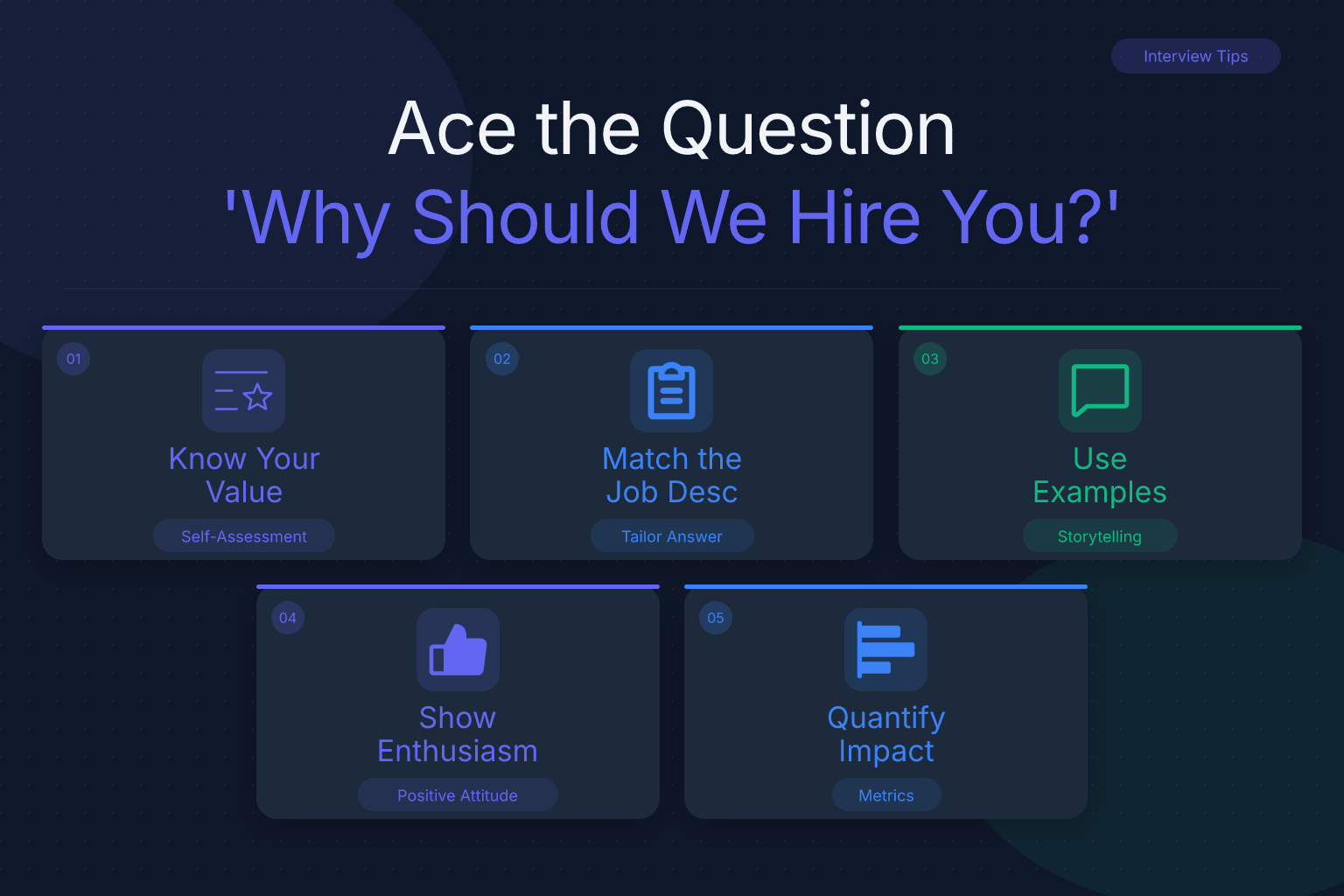
- Structure your answer in three parts: acknowledge the company’s specific needs, prove you can meet them with a quantified past accomplishment, and connect your motivation to their mission or culture.
- Research the job description, company website, and employee insights to identify the top problems they need solved, then map your skills directly to those needs.
- Avoid common mistakes like being too humble, reciting your resume, giving generic answers, or speaking for more than two minutes; instead, use concrete, evidence-based examples.
- Practice your answer by outlining key points rather than memorizing a script, and record yourself to ensure a conversational tone and a length of 90 seconds to two minutes.
The 3-Step Formula to Answer “Why Should We Hire You?”
Interviewers ask this question to see if you understand the role, gauge your confidence, and compare you to other candidates. A strong answer shows you’ve done your homework and can connect your skills to their specific needs. Use this simple three-step structure to stay on track.
Step 1: Show You Understand Their Needs
Start by acknowledging what the company is looking for. Reference a specific challenge, goal, or requirement from the job description. This immediately signals that you’re not giving a generic speech.
Example opening: “Based on the job description, it sounds like you need someone who can not only manage the existing client accounts but also identify upsell opportunities to grow revenue.”
Step 2: Prove You Can Deliver Results
Now connect your experience directly to that need. Use a concrete example — a past accomplishment, a project, a skill — that demonstrates you’ve done it before and can do it again. Quantify whenever possible.
Example bridge: “In my last role, I took over a stagnant account portfolio and increased quarterly revenue by 22% within six months by introducing a consultative sales approach.”
Step 3: Explain Why You’re the Right Fit
Close by tying your motivation and work style to the company’s culture or mission. This makes you more than a set of skills — it makes you someone they want on the team.
Example closing: “I’m also drawn to your company’s focus on sustainable packaging. I’ve been following your initiatives, and I’d love to bring my sales background to a mission I genuinely care about.”
When you combine these three elements, you give the interviewer a complete, compelling reason to hire you — not just a list of adjectives.
How to Research and Match Your Skills to the Job
You can’t tailor your answer without solid research. Here’s a quick, effective process:
- Read the job description like a detective. Highlight every required skill, preferred qualification, and soft skill mentioned. These are your keywords.
- Study the company’s website and recent news. Look for their mission statement, values, recent product launches, or press releases. Find something that genuinely excites you.
- Check LinkedIn and Glassdoor. See what employees say about the culture, and look at the backgrounds of people in similar roles. This gives you clues about what they value.
- Identify the top 3 problems they need solved. For a customer service role, it might be reducing response time. For a marketing role, it might be generating more qualified leads. Frame your answer around solving those problems.
Once you’ve identified the top needs, map your skills directly to the job description. For example, if you’re applying for a Project Manager role at a mid‑sized tech company, the job description might emphasize:
- Leading cross‑functional teams
- Delivering projects on time and under budget
- Experience with Agile/Scrum
- Strong stakeholder communication
Your answer should hit each of those points with a specific story. Here’s how you might map them:
| Job Requirement | Your Proof Point |
|---|---|
| Cross‑functional leadership | “I led a team of engineers, designers, and QA to launch a mobile app update.” |
| On‑time, under‑budget delivery | “We shipped two weeks early and saved 15% of the allocated budget by renegotiating vendor contracts.” |
| Agile/Scrum experience | “I’m a Certified ScrumMaster and ran daily stand‑ups, sprint planning, and retrospectives.” |
| Stakeholder communication | “I presented monthly progress to the C‑suite and turned their feedback into actionable backlog items.” |
Now weave those into the 3‑step formula, and you have a tailored, evidence‑backed answer that directly addresses what they care about.
Sample Answers for Different Career Stages
Entry‑Level Candidate (Recent Graduate)
“I know you’re looking for a marketing coordinator who can hit the ground running with social media and content creation. During my internship at a local agency, I managed Instagram and TikTok accounts that grew engagement by 40% in three months. I also wrote blog posts that consistently ranked on page one for target keywords. Beyond the skills, I’m genuinely passionate about the ed‑tech space — I used your platform as a student, and I’d love to help more learners discover it.”
Why it works: It acknowledges lack of full‑time experience but compensates with specific internship results and genuine enthusiasm for the company’s mission.
Experienced Professional (Mid‑Career)
“From our conversation, it’s clear you need a sales leader who can turn around an underperforming territory and build a high‑performing team. At my current company, I inherited the lowest‑ranked region and moved it to #2 in revenue within 18 months by restructuring the sales process and mentoring three new reps who each exceeded quota. I’m also excited about your expansion into the European market — I’ve managed remote teams across time zones and would love to apply that experience here.”
Why it works: It directly addresses a business problem, quantifies the turnaround, and shows strategic alignment with the company’s growth plans.
Career Changer
“I understand you need a data analyst who can translate complex datasets into actionable insights for the product team. While my background is in operations management, I’ve spent the last two years upskilling in SQL, Python, and Tableau — and I’ve already applied those skills to reduce inventory waste by 12% in my current role. I’m not just looking for any analyst job; I specifically want to work in e‑commerce because I’ve seen how data can transform the customer experience, and your company’s focus on personalization aligns perfectly with that.”
Why it works: It reframes a career pivot as a strength, shows concrete upskilling, and connects the candidate’s unique perspective to the company’s goals.
Common Mistakes and How to Avoid Them
Even a well‑intentioned answer can fall flat if you make these errors:
- Being too humble. “I think I could probably do the job” sounds uncertain. Replace it with confident, evidence‑based statements.
- Reciting your resume. The interviewer already read it. Use this time to connect the dots, not repeat bullet points.
- Giving a generic answer. “I’m a hard worker and a fast learner” means nothing without context. Always tie traits to specific results.
- Talking too long. Aim for 90 seconds to two minutes. If you go over, you risk losing their attention.
- Forgetting to mention the company. If your answer could apply to any employer, it’s not tailored enough. Name the company and reference something specific.
- Sounding arrogant. There’s a fine line between confidence and cockiness. Frame your achievements as team efforts or results of learning, not as proof you’re a genius.
Instead, reframe your answer with concrete evidence. For example, rather than saying “I’m a hard worker,” say: “I consistently met tight deadlines, even when managing three projects simultaneously, which led to a 10% increase in team efficiency.” This shows, not just tells, your value. A positive, specific example always beats a vague claim.
How to Practice, Deliver, and Handle Unexpected Questions
A great answer on paper can still sound robotic if you don’t practice. Here’s how to make it feel conversational:
- Write a bullet‑point outline, not a script. You want key phrases and stories, not a word‑for‑word monologue.
- Record yourself on your phone. Listen for filler words (“um,” “like”), pacing, and tone. Adjust until you sound like you’re talking to a colleague.
- Practice with a friend or mentor. Ask them to throw the question at you unexpectedly, just like in a real interview.
- Time yourself. Keep it under two minutes. If it’s too long, cut the least relevant example.
- Prepare for follow‑up questions. If you mention a 22% revenue increase, be ready to explain how you achieved it. For more on handling curveball questions, see our guide on second interview questions and how to answer them.
If You’re Asked Unexpectedly
Sometimes the question comes out of nowhere — maybe in a phone screen or a casual conversation. Here’s how to handle it on the spot:
- Buy yourself a few seconds. Say, “That’s a great question. Let me take a moment to give you a thoughtful answer.” This shows poise.
- Quickly scan your mental notes. Think of the top 2–3 requirements of the job and your strongest matching accomplishment.
- Use a simple bridge. “Based on what I know about the role, you need someone who can X. In my last position, I did Y, which resulted in Z. I’m also excited about your company’s focus on A, and I’d love to contribute to that.”
- Keep it short. When you’re thinking on your feet, it’s better to deliver one strong point than to ramble.
Even an impromptu answer can impress if you stay calm and structured.
How This Question Connects to Other Interview Questions
“Why should we hire you?” rarely stands alone. It often follows or overlaps with questions like “Tell me about yourself” and “What are your greatest strengths?” Understanding the differences helps you avoid repeating yourself. For example, here’s how you might answer each for a marketing role:
- Tell me about yourself: “I’m a marketing professional with five years of experience in content strategy and social media management. I started my career at a startup where I built the blog from scratch, and now I lead a team of three at a mid-sized agency.”
- What are your greatest strengths? “My greatest strength is data-driven storytelling. I use analytics to identify what content resonates, which helped increase organic traffic by 40% in my last role.”
- Why should we hire you? “Based on your need for a content lead who can scale your blog and drive lead generation, I’ve done exactly that: at my current company, I grew monthly blog traffic from 10K to 50K and generated 200+ qualified leads per month. I’m also excited about your focus on sustainability, which aligns with my personal passion.”
Notice how the “why should we hire you” answer is the most tailored and forward-looking, directly connecting past results to the company’s specific goals. For a deep dive on the first question, read how to answer tell me about yourself in an interview.
FAQ
Q: What is the best way to answer “Why should we hire you?”?
A: The best way is to use a 3‑step formula: show you understand the company’s needs, prove you can meet them with a specific accomplishment, and explain why you’re a great culture fit. Tailor every answer to the specific job and company.
Q: How long should my answer be?
A: Aim for 90 seconds to two minutes. That’s enough time to deliver one or two concrete examples without losing the interviewer’s attention. If you have multiple strong points, choose the most relevant one rather than cramming everything in.
Q: Can I use the same answer for every interview?
A: No. A generic answer signals that you haven’t done your research. Always customize your response to reflect the company’s specific challenges, values, and the job description’s requirements.
Q: What if I don’t have much experience?
A: Focus on transferable skills, academic projects, internships, volunteer work, or self‑initiated learning. Frame your lack of experience as a fresh perspective and eagerness to grow, and back it up with a concrete example of how you’ve quickly learned something new.
Q: How do I avoid sounding arrogant?
A: Use phrases like “I was fortunate to be part of a team that…” or “I learned that I could contribute by…” instead of “I single‑handedly.” Always acknowledge collaboration and give credit where it’s due. Confidence is about stating facts, not claiming superiority.
Q: Should I mention salary expectations in this answer?
A: No. This question is about your value to the company, not your cost. Save salary discussions for later stages when the employer brings it up.
Q: What if I’m asked this in a group or panel interview?
A: Address the whole panel, make eye contact with each person, and tailor your answer to the collective needs of the team. For more tips on panel settings, see our guide on how to prepare for panel interview questions.
Related articles:
- How Do You Learn New Skills? Interview Answer & Examples
- How do you stay organized? Interview answer + examples
- Answering ‘How Do You Prioritize Your Work?’ (Examples)
- Decision-Making Style: How to Answer (Examples)
- What Makes You Unique? How to Answer (Examples)
- Why Work for This Company? Answer Examples to Get Hired
- How to Answer “What Is Your Notice Period?” (With Examples)
- Video Resume Pros and Cons: Should You Send One?
- Career Goals Interview: How to Answer (With Examples)
- Your Greatest Strengths? Interview Answer Examples
- Tell Me About a Time You Failed: How to Answer (Examples)
- Answer ‘Where Do You See Yourself in 5 Years?’ Examples
Track Every Application While You Job Hunt
Stop losing track of where you’ve applied. The ResumeMate Job Tracker is a free Chrome extension that tracks every application, deadline, and follow-up in one place — right from your browser.