What Are Your Greatest Strengths? Interview Answer Examples That Work
When an interviewer asks, “What are your greatest strengths?” they aren’t just making small talk. This question is a direct invitation to sell yourself — and most candidates fumble it by either reciting a generic list of adjectives or bragging without proof. The good news: with a little preparation, you can turn this predictable question into a compelling reason to hire you.
Below, you’ll find a step-by-step guide to choosing the right strengths, structuring your answer, and delivering it with confidence. We’ve included 10 real-world answer examples for different roles and experience levels, plus a summary table you can scan in seconds.
Key Takeaways
- The “greatest strengths” question is a behavioral prompt — interviewers want a specific, proven strength, not a list of buzzwords.
- Choose a strength that directly matches the job description and back it up with a concise STAR (Situation, Task, Action, Result) story.
- Avoid vague claims like “I’m a hard worker” — instead, describe a time you solved a problem, led a project, or learned a skill quickly.
- Practice your answer out loud so it sounds natural, not rehearsed, and always tie the strength to the value you’ll bring to the company.
- Pair this question with a prepared answer for “What is your greatest weakness?” to show self-awareness and growth.
| What to Do | Why It Matters | Time |
|---|---|---|
| Pick a strength from the job description | Shows you’ve done your research and the strength is relevant | 5 min before the interview |
| Use the STAR method (Situation, Task, Action, Result) | Gives your answer structure and proof, not just claims | 2–3 min to deliver |
| Quantify the result when possible | Numbers make your story memorable and credible | 30 seconds to add a metric |
| Practice with a friend or record yourself | Eliminates filler words and helps you sound confident | 15–20 min total |
| Prepare a backup strength in case they ask for another | Shows depth and keeps you from freezing | 5 min extra prep |
Why Interviewers Ask “What Are Your Greatest Strengths?”
This question serves three purposes. First, it tests self-awareness — can you honestly assess what you’re good at? Second, it reveals whether you understand the role. If you claim a strength that has nothing to do with the job, you’ll look unprepared. Third, it’s a behavioral question in disguise. The best answers don’t just list strengths; they prove them with a short story.
Hiring managers often ask this early in the interview to set a positive tone. A strong answer builds momentum. A weak one — “I’m a perfectionist” or “I work too hard” — can make the rest of the conversation an uphill battle. Treat this as your chance to frame the entire interview around what you do best.
If you’re also preparing for the flip side, check out our guide on how to answer “What are your weaknesses?” — the two questions are often asked back-to-back.
How to Choose the Right Strengths to Highlight
Don’t guess. The job description is your cheat sheet. Scan it for the top three to five skills or qualities the employer wants. Then map your own experiences to those. For example, if the posting emphasizes “cross-functional collaboration,” your strength might be “building alignment across teams.” If it mentions “data-driven decision-making,” you could highlight “analytical problem-solving.”
Here’s a quick process:
- Print or open the job description and highlight every skill, trait, and responsibility.
- Group them into themes — e.g., leadership, technical expertise, communication, adaptability.
- For each theme, recall a specific win from a past job, internship, or project.
- Pick the one story that feels most impressive and relevant to the company’s current challenges.
If you’re early in your career, strengths like “fast learner,” “resilience,” or “initiative” can work — as long as you back them with a concrete example. For instance, “I taught myself Python in two weeks to automate a manual reporting task that saved my team 10 hours a month.”
The STAR Method for Structuring Your Answer
A rambling story loses the interviewer. Use the STAR framework to keep your answer tight and persuasive:
- Situation: Set the scene. Where were you? What was the context?
- Task: What was your responsibility or the challenge you faced?
- Action: What specific steps did you take? Focus on your contribution.
- Result: What happened? Quantify the outcome if possible.
A full STAR answer should take 60–90 seconds. Practice until you can deliver it without sounding like you’re reading from a script. The goal is a natural, conversational story that demonstrates the strength in action.
10 Greatest Strengths Interview Answer Examples
Here are sample answers for common strengths, tailored to different roles. Use them as inspiration, not a script — swap in your own details.
1. Leadership (for management roles)
“My greatest strength is turning underperforming teams around. In my last role as a shift supervisor, I inherited a team with low morale and missed deadlines. I started by holding one-on-ones to understand their frustrations, then restructured our workflow to give each person more ownership. Within three months, our on-time delivery rate went from 72% to 94%, and two team members were promoted.”
2. Problem-solving (for engineering, IT, or operations)
“I’m a natural problem-solver. When our customer support ticket backlog grew by 40% after a product launch, I dug into the data and found that 30% of tickets were caused by a single unclear error message. I worked with the product team to rewrite it, and within a week, related tickets dropped by 60%. I enjoy finding the root cause instead of just treating symptoms.”
3. Communication (for sales, marketing, or client-facing roles)
“I excel at translating complex ideas into simple language. As a marketing coordinator, I was asked to present our quarterly analytics to the leadership team — none of whom had a marketing background. I replaced jargon with clear visuals and tied every metric to a business outcome. The CEO later told me it was the most useful marketing update she’d ever received.”
4. Adaptability (for startups, fast-changing industries)
“I thrive in environments where things change quickly. At my previous company, we pivoted our entire product strategy six weeks before launch. I volunteered to lead the customer research sprint, conducted 20 interviews in five days, and delivered insights that shaped the new roadmap. The product launched on time and beat its first-month user target by 25%.”
5. Attention to detail (for accounting, legal, or quality assurance)
“My strength is catching errors before they become problems. While reviewing a client’s quarterly financial statements, I noticed a $15,000 discrepancy that had been missed for two consecutive quarters. I traced it back to a misclassified expense, corrected it, and created a checklist that prevented similar errors going forward. The client renewed their contract and expanded our engagement.”
6. Collaboration (for cross-functional roles)
“I’m skilled at bringing different departments together. On a website redesign project, the design and engineering teams were at odds over timelines. I organized a joint workshop where each side mapped out their constraints, then proposed a phased rollout that satisfied both. The project shipped two weeks early, and we established a collaboration playbook that’s still used today.”
7. Time management (for administrative or project management roles)
“I’m extremely organized and good at prioritizing. When I started as an executive assistant, the CEO was spending 10 hours a week on email. I created a triage system, drafted responses for routine inquiries, and blocked focus time on her calendar. She gained back eight hours a week, which she used to close two major partnerships.”
8. Technical expertise (for specialized roles)
“My greatest strength is my deep knowledge of SQL and data modeling. At my last job, our reporting dashboards were slow and often crashed. I redesigned the underlying data schema, optimized the queries, and cut report load times from 45 seconds to under 3 seconds. The sales team started using the dashboards daily instead of avoiding them.”
9. Creativity (for design, content, or innovation roles)
“I bring a creative approach to content strategy. When our blog traffic plateaued, I proposed a series of interactive tools instead of traditional articles. I built a simple ROI calculator in partnership with a developer, and it became our top-traffic page within two months, generating 1,200 qualified leads in the first quarter.”
10. Resilience (for high-pressure roles)
“I stay calm and focused under pressure. During a system outage that affected 5,000 users, I coordinated the incident response while keeping stakeholders updated every 30 minutes. We restored service in under two hours, and I led the post-mortem that resulted in a new monitoring system, preventing a repeat incident.”
How to Tailor Your Strengths to the Job Description
Generic answers get generic results. Before the interview, identify the company’s biggest pain point. If they’re scaling rapidly, emphasize adaptability and process-building. If they’re in a regulated industry, highlight attention to detail and compliance experience.
Look beyond the job posting. Read the company’s blog, recent press releases, and the interviewer’s LinkedIn profile. If the team just launched a new product, your strength could be “launching products under tight deadlines.” If they’re expanding internationally, “cross-cultural communication” becomes a powerful answer.
When you’ve tailored your resume to land the interview, make sure your strengths answer aligns with the same narrative. A consistent story — from resume to interview — builds trust. If you haven’t yet optimized your resume for the role, you can check your resume’s ATS score free to see if it’s highlighting the right strengths.
Common Mistakes to Avoid When Answering
Even well-prepared candidates can sabotage their answer with these missteps:
- Listing adjectives instead of telling a story. “I’m hardworking, dedicated, and a team player” means nothing without proof. Every strength needs a mini-story.
- Choosing a strength irrelevant to the job. Saying “I’m a great public speaker” for a data entry role confuses the interviewer. Pick something that solves their problem.
- Being too humble. This is not the time to downplay your achievements. Own your wins.
- Rambling. If your answer exceeds two minutes, you’ve lost them. Practice with a timer.
- Using a fake weakness as a strength. “I care too much” or “I work too hard” are clichés that annoy interviewers. For a genuine approach to the weakness question, see our guide on answering “What is your greatest weakness?”.
How to Practice Your Answer
Reading a script in your head isn’t practice. You need to speak the words out loud. Here’s a routine that works:
- Write bullet points, not a script. Jot down the STAR elements — a few words each — so you sound natural.
- Record yourself on your phone. Listen for filler words (“um,” “like”), pacing, and clarity.
- Practice with a friend and ask for honest feedback. Did they understand the story? Was it convincing?
- Time yourself. Aim for 60–90 seconds. If it’s too long, cut unnecessary details.
- Prepare a second strength. Some interviewers ask, “What’s another strength you’d bring?” Have a backup ready.
If you’re preparing for a second-round interview, the questions often get deeper. Our post on second interview questions and how to answer them can help you level up. For another common question, see our guide on answering “Where do you see yourself in 5 years?”.
What to Do If You’re Not Sure About Your Strengths
If you’re struggling to identify your strengths, start by asking people who know your work. Former managers, colleagues, or even clients can point out patterns you overlook. Look at past performance reviews — what did people consistently praise?
You can also work backward from results. Think of three accomplishments you’re proud of. What strength made each possible? For example, if you organized a successful event, strengths might include project management, vendor negotiation, or calmness under pressure.
Finally, consider taking a reputable assessment like the VIA Character Strengths survey or Gallup’s CliftonStrengths. These tools give you a vocabulary for strengths you may take for granted. Just remember: the interview answer still needs a real-world example, not just a label.
If you’re still clarifying your career direction, our guide on answering career goals interview questions can help you build a consistent narrative that ties your strengths to your future.
FAQ
Q: What is the “greatest strengths” interview question?
A: The question is typically phrased as “What are your greatest strengths?” or “What would you say is your biggest strength?” It’s a behavioral question designed to see if you can identify a relevant skill and back it up with a real example. The best answers pick one strength, prove it with a short STAR story, and connect it to the job.
Q: How do I answer “What are your greatest strengths?” with no experience?
A: Focus on transferable skills from school, volunteering, or personal projects. Strengths like “fast learner,” “resilience,” or “initiative” work well if you can share a concrete example. For instance, “I taught myself graphic design to create marketing materials for a student club, which increased event attendance by 30%.” The key is to show you can apply the strength to the workplace.
Q: Can I mention more than one strength in my answer?
A: It’s best to lead with one strong, well-developed example. If the interviewer asks for another, have a backup ready. Listing multiple strengths without stories dilutes your impact. A single, memorable story is more persuasive than a list of adjectives.
Q: What are some examples of greatest strengths for a job interview?
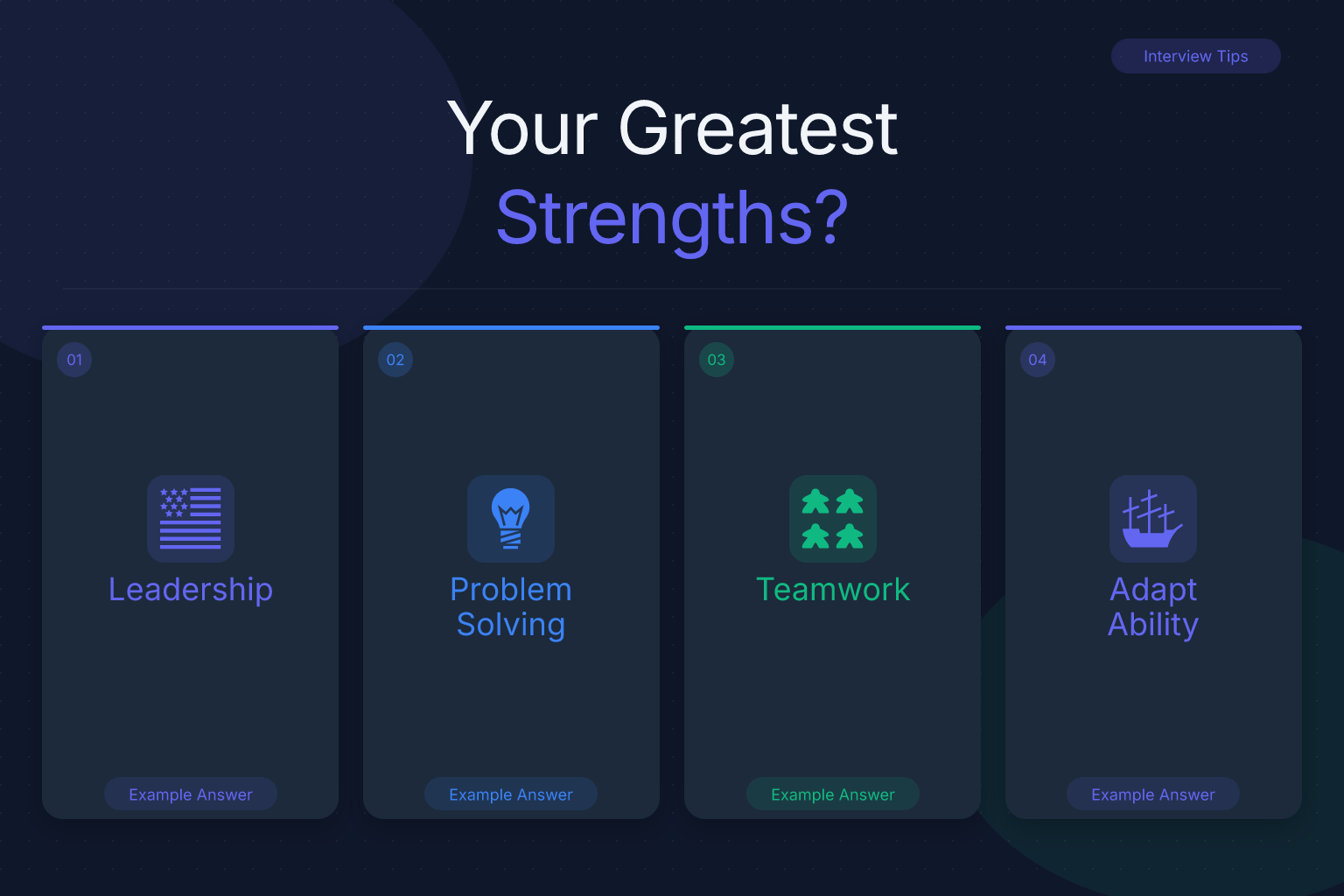
A: Common strengths that work well include leadership, problem-solving, communication, adaptability, attention to detail, collaboration, time management, technical expertise, creativity, and resilience. The key is to choose the one most relevant to the job description and support it with a specific achievement. (See the 10 examples above for inspiration.)
Q: How do I answer “What is your greatest strength and weakness?” in the same interview?
A: Answer them separately, but make sure they don’t contradict each other. For strengths, use the STAR method. For weaknesses, pick a real, non-fatal weakness and show how you’re improving. Avoid clichés like “I’m a perfectionist.” For a deeper dive on the weakness part, see our guide to answering “What is your greatest weakness?”.
Q: What if I don’t know my greatest strength?
A: Ask former managers or colleagues for feedback, review past performance reviews, or think of three accomplishments you’re proud of and identify the strength behind each. You can also take a strengths assessment like CliftonStrengths. Once you have a candidate, test it with a STAR story to see if it feels authentic and impressive.
Q: How long should my answer be?
A: Aim for 60–90 seconds. That’s enough time to set up the situation, describe your action, and share the result without rambling. Practice with a timer to stay concise.
Related articles:
- Solved a Problem: Interview Answer Guide (Examples)
- Describe Your Work Style: Answers & Examples
- Describe Your Leadership Style: Interview Answer Examples
Track Every Application While You Job Hunt
Stop losing track of where you’ve applied. The ResumeMate Job Tracker is a free Chrome extension that tracks every application, deadline, and follow-up in one place — right from your browser.